- Adam Gray Valley Solutions
- Posts
- Valley Solutions

Valley Solutions offers a daily look at the top headlines appearing on media websites affecting the San Joaquin Valley. It is compiled by Mike Dunbar, who worked in Stockton, Modesto, Merced and Los Banos media for 40 years. Valley Solutions is brought to readers by Adam Gray.
Reach Mike Dunbar at [email protected].
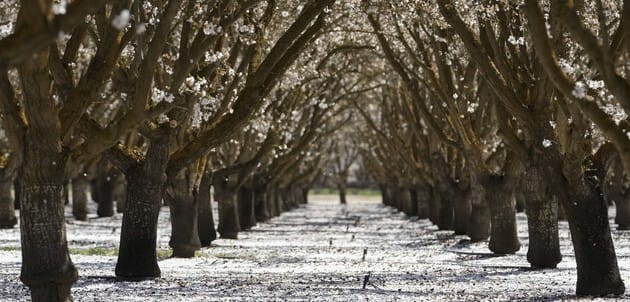
Almond blossoms blanket a Valley orchard in February.
Giving up on counting nuts?
Patterson Irrigator. Almond board votes to stop funding USDA crop forecast.
Synopsis: The Irrigator picks up the CA Farm Bureau story detailing the Almond Board’s decision to stop funding the USDA’s Objective Estimate. Growers greeted the board’s decision with applause. Last year’s Objective Estimate, released in July, predicted a near-record crop, causing the price of almonds to drop overnight. The board said it would continue to collaborate with the USDA to refine estimates of crop size, and it would continue with its May estimate based on grower data. Meanwhile, the board noted a partnership with Bollywood star Ananya Panday and cricket star Rishabh Pant to promote almonds in India – the largest export market for California nuts.
GV Wire. Key forecast killed after almond-price collapse. Was it a knee-jerk decision?
Synopsis: Reporter Edward Smith looks at the Almond Board’s decision to end funding of the USDA’s Objective Estimate and its outsized influence on almond prices. He quotes the Punjabi American Growers Group saying last July’s faulty estimate “cost growers $1.2 billion overnight.” The price of almonds dropped 16%, or by 50 cents a pound after the estimate of 3.2 billion pounds was released. That was wrong by at least 300 million pounds, according to preliminary data, and possibly as much as 500 million pounds. Some growers even suspect collusion between the USDA and nut processors – who buy almonds. It wasn’t the first time the USDA had overestimated the crop in July. In 2024, the Objective Estimate was off by 2.5%. Critics say abandoning the estimate will lead to instability in nut markets.

State wants a shortcut from the Sacramento to the pumps.
Court rejects tunnel bonds
SF Chronicle. Newsom’s Delta tunnel plan hits snag as court rules state lacks authority to issue bonds.
Synopsis: On New Year’s Eve, an appeals court ruled the state lacks authority to issue bonds to finance the 45-mile Delta tunnel that would carry water from the Sacramento River directly to the pumps near Tracy. The state had argued the legislature authorized the bonds when it approved the Feather River Project, which includes dams and hydroelectric plants north of Sacramento. But Judge Peter Krause of the state’s Third District agreed with Judge Kenneth Mennemeier, who had ruled in 2024 that an explicit vote by the legislature was required before bonds could be issued. Without bond funding, the state cannot proceed with the project.

Kevin Lincoln in north Stockton.
He can have this endorsement
Turlock Journal. Gray not surprised by Trump’s endorsement of opponent in D-13 seat.
Synopsis: A former, one-term Stockton mayor is emerging as the Republicans’ choice to challenge Adam Gray in California’s 13th Congressional District – the most competitive district in the nation. Kevin Lincoln has been endorsed by Donald Trump. “The only surprising thing here is that Kevin Lincoln would actually want this endorsement,” said Gray campaign spokesman Ben Rodriguez. “Tarrifs, health care cuts and a rising cost of living – that’s (Trump’s) record. Valley families deserve better, and Congressman Adam Gray is delivering. He’s fighting to lower costs and protect access to affordable healthcare.” Lincoln ran against Josh Harder in 2022 and 2024, losing both races. This year he’s moving his focus south. Meanwhile, the wife of former Rep. John Duarte officially became one of four candidates trying to remove fellow Republican Marie Alvarado-Gil from the state senate.
Consequences for MID’s failure?
Valley Citizen. Irrigation District’s failure to manage water threatens stakeholders.
Synopsis: Publisher Eric Caine points out the “can of worms” waiting to be opened at Modesto Irrigation District. He notes the clear evidence that director Larry Byrd has been using district water to irrigate 96 acres of almonds outside the district. The investigation into where the water came from was halted on a 2-2 vote in which Byrd participated. Caine writes that other Tuolumne River stakeholders – TID, the city of San Francisco mainly – should be interested in seeing this investigation continue. The vote not to continue the investigation “reveals even more about MID’s failings than Byrd’s.”

Rice farmers will get $132 an acre in bailout money.
Farm bailouts detailed
Morning Ag Clips. Farmers can now learn how much aid they will get from the Trump administration.
Synopsis: Trump’s $12 billion ag-aid package is laid out with “per acre” payments for various commodities based on cost of production. Soybean farmers will get $30.88 per acre while corn growers will get $44.36 and sorghum $48.11. Payments will be capped at $155,000. American Soybean Assn president Caleb Ragland called the payments “a Band-Aid on a deep wound. We need competition and opportunities in the markets.” Minnesota’s Soybean Growers Assn president said the number was well short of what he expected. Regardless, most farmers “remain steadfast supporters of Trump even after the disruptions caused by his trade war.” Meanwhile, the USDA announced China purchased 600,000 metric tons of soybeans by Dec. 31, well short of the 12,000,000 tons promised and last year’s 28 million tons.
Successful Farming. USDA reveals commodity payment rates for Bridge Assistance Program.
Synopsis: They story is similar to others but offers a more complete list of commodities eligible for payments. Some of those crops are grown in California, such as chickpeas ($33.36 per acre), cotton $117.35, oats $81.75, wheat $39.35 and rice $132.89. Payments won’t arrive until Feb. 28.
Mostly good news for salmon
CBS13. Yuba River sees highest salmon numbers in more than a decade.
Synopsis: A nonprofit that tracks salmon populations on the Yuba River says it was a banner year with over 6,200 returning fish. In the last 5 years, more than 200 acres of floodplain have been restored on the Yuba. As the report notes: “Restoration science is being implemented around the state, with many other streams and waterways seeing similar results.”
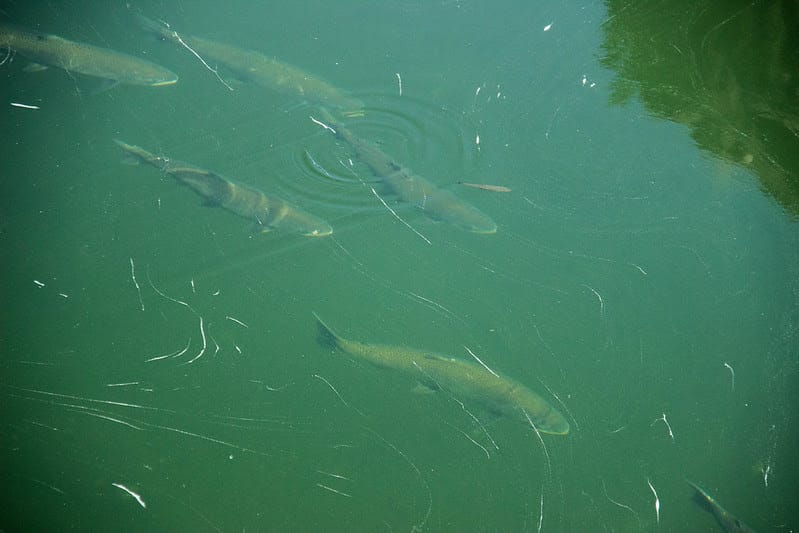
Some of the 6,200 salmon who came up the Yuba to spawn.
KCRA. Record salmon run in Putah Creek.
Synopsis: A record 2,100 Chinook salmon have returned to spawn in Putah Creek in Solano County. The creek had suffered from pollution and blocked upstream habitat, leading to the loss of all salmon. Restoration efforts cleaned the water and removed debris from the creek while creating more habitat for rearing juvenile fish.
Maven / NOAA. Conflicting ocean indicators suggest moderate returns of Pacific salmon.
Synopsis: Researchers at Oregon State and the NOAA examined 16 ocean indicators ranging from temperature to salinity and concluded salmon in the ocean were slightly better off this year than last. Juvenile coho showed a significant surge compared to previous years. Overall, indicators placed the year in the middle of conditions – some better, some worse.

A Sikh immigrant who works in CA’s trucking industry.
State backs Sikh truckers
LA Times. CA sets up showdown with Washington by reissuing licenses to migrant truckers.
Synopsis: Transportation Sec Sean Duffy has threatened to cut $160 million in funding for California after the state delayed cancellation of thousands of commercial truck-driving licenses and extended the deadline to reapply for renewal. DMV Director Steve Gordon called immigrant drivers largely from India “an important part of our economy – our supply chains don’t move, and our communities don’t stay connected without them.” The Sikh Coalition and Asian Law Caucus urged the state to take action. “We are extremely relieved to see this within the community,” said Bakersfield vice mayor Manpreet Kaur. An estimated 150,000 Punjabi Sikhs work in the trucking industry, including 17,000 drivers.

Patterson Fire Chief Jeff Frye.
What’s up with the PFD?
Patterson Irrigator. City releases third-party assessment of Patterson fire chief.
Synopsis: Chief Jeff Frye was hired by the Patterson City Council in 2024 to oversee the city department and the West Stanislaus Fire Protection District, made up of volunteers. The Patterson Firefighters Assn last year delivered a vote of “no confidence” on Frye. But the West Stan firefighters submitted a letter expressing a “formal show of support” for the chief. Municipal Resource Group was tasked with looking into the controversy and concluded that PFD is a “department that stands at a crossroads.” There were no indications of scandal or malfeasance, just broad discontent among Patterson employees. While the chief’s goals, policies and standards are consistent with modern fire service, his communication skills have been lacking, said the report. It also criticized the firefighters union.

A drawing of the new Mercy Village in Merced.
One shelter survives, one thrives
Modesto Bee. After unpredictable year, Turlock’s only low-barrier men’s shelter has survived.
Synopsis: Reporter Julietta Bisharyan revisits the We Care Shelter in downtown Turlock, which is still serving 49 homeless men. It was shuttered for a month after the city refused to provide token support needed to secure a state grant. But donations from various community groups kept the shelter in operation. Now, the city is once again partnering with We Care in a two-year program to subsidize rents in the Rapid Re-Housing program. Another grant, with the La Familia nonprofit, provides counseling and mental health counseling for residents.
ABC30. Merced granted $30 million from state for another affordable housing complex.
Synopsis: The state’s Home Key program is sending Merced $30 million to build housing for those in need. First call will be for veterans, but others are expected to qualify for one of 66 units at Mercy Village. It will be the fourth project in Merced paid for by the Home Key program.
Turlock gets a bookstore
Turlock Journal. Book lovers rejoice, Barnes & Noble is coming to town.
Synopsis: The national bookstore chain will open a store in the Monte Vista Crossing center this year. It will be the city’s only bookshop following the closure of Lightly Used Books last March. The nation’s largest bookseller, B&N appeared destined for bankruptcy just three years ago. But it was acquired by the British firm Waterstones, which emphasizes local control of its stores. Turlock will be one of 60 cities getting a new Barnes & Noble.

Lick Observatory atop Mt. Hamilton overlooking the Valley.
114 mph winds at Lick
SF Chronicle. Lick Observatory remains closed after ‘devastating’ winter storm.
Synopsis: The UC-owned Lick Observatory, which sits atop Mount Hamilton on the western edge of the Valley, will remain closed to the public after a Christmas Day storm destabilized the building. Winds gusting to 114 mph tore off half the shutters protecting the Great Refractor Dome, causing severe structural damage. The observatory’s telescopes and electronics are vulnerable to rain. “We may build a remote-control facility elsewhere on the mountain,” said UC officials.
Strange lights over Fresno
Fox26. Strange lights spotted on New Year’s Eve: ‘Never seen anything like this in my life.’
Synopsis: Art Garcia, who lives near First and Clinton avenues in Fresno, saw and photographed three orange lights moving in unison through the sky around 10:25 pm on New Year’s Eve. There was no noise. Moving horizontally, they weren’t fireworks or aircraft. The station is asking if anyone else saw the lights.

The odd orange lights that hovered over Fresno. Drones?