- Adam Gray Valley Solutions
- Posts
- Valley Solutions

Valley Solutions offers a daily look at the top headlines appearing on media websites affecting the San Joaquin Valley. It is compiled by Mike Dunbar, who worked in Stockton, Modesto, Merced and Los Banos media for 40 years and later served as Adam Gray’s press secretary when he was in the Assembly. Valley Solutions is brought to readers by Rep. Adam Gray.
Reach Mike Dunbar at [email protected].

DWR scientists measuring snow and water in El Dorado County.
Another level of drought
The Guardian. ‘On a whole other level’: Rapid snowmelt in American West stuns scientists.
Synopsis: The snow surveys taking place across the US West this week are resulting in a very grim prognosis. An historically warm winter with record-breaking March temperatures has left critical snowpacks across all major watersheds at levels never before seen. Scientists are using words like “unprecedented” and “stunning.” Even if it snows in the next two weeks, it will be far too little and much too late. “This year is on a whole other level,” said Colorado State climatologist Russ Schumacher. It’s not just that it’s the driest year on record, but the numbers are “so far below any of the other years” that scientists are “very concerned.”
SF Chronicle. Here’s what CA’s dismal snowpack means for the state’s future.
Synopsis: Scientist Peter Gleick writes about the utterly dismal snowpack in the Sierra. Instead of the 27 inches we should be seeing on April 1, we’ve got 5 inches. “What we’re seeing is a clear signal of human-caused climate change,” he said. “CA received about its average precipitation this winter, but only a small fraction was snow.” High temps evaporated most of the water and most of the rest soaked into the ground. Any runoff flowed into full reservoirs and had to be released. “Without the snowpack, we will draw down our reservoirs earlier, cutting into our reserves and worsening the impact of the inevitable droughts we suffer,” writes the Pacific Institute founder.
Final ‘snow survey’ is scary
KCRA. CA’s final snow survey comes after abnormally dry, warm March.
Synopsis: Water officials went to Phillips Station on Hwy 50 in El Dorado to measure the snow, just as they’ve done for decades. What they found in the season’s final snow survey was mostly bare ground. Such surveys have been superseded by more accurate methods of measuring the snow. But both methods are reporting worrisome numbers. Statewide the snowpack is at 18% of average. In the Central region it’s 20% and the Southern region 33%. The Northern region is really dry, at 6% of normal.
Redding Record-Searchlight. Rain this week may not be enough to stop summer drought.
Synopsis: This week’s wet storm will be nice after a dry March, but not nearly enough to ward off a looming summer drought. Officials worry that the coming fire season will be intense with forecasts of extremely high temperatures drying fuels more quickly.
Lost Coast Outpost. This has been Eureka’s driest March in 100 years, the second-driest ever recorded.
Synopsis: It’s been 100 years since it was this dry in Eureka, as less than half an inch of rain fell in the city during March. Since record-keeping began in 1886, the driest March was in 1926, when there was zero rainfall recorded.
Would-be governors visit Valley
Modesto Bee. Gubernatorial candidate speaks at Si Se Puede lunch in Modesto.
Synopsis: Kathleen Quinn went to the Si Se Puede luncheon, formerly known as the Cesar Chavez Celebration, during which several speakers addressed the fall of an icon. Xavier Becerra spoke of being a farmworker and his admiration for Chavez and his participation in the grape boycott. But, he said, the movement “is more than one person. It is about us.” Organizers read the names of UFW members who have been killed by ICE agents this year. Becerra said if elected governor, he will increase wages and respect for farmworkers. “Anyone who works hard should not have to stop by a food pantry on the way home.”
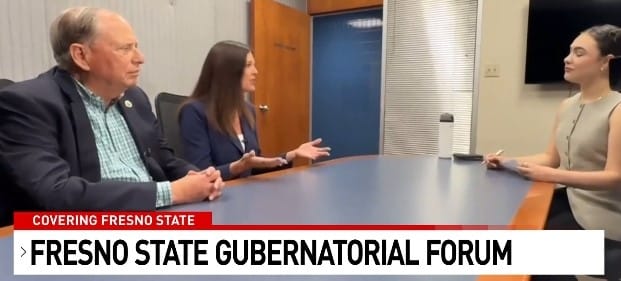
Buddy Mendes and Kristin Olsen speak to a reporter.
Fox26. Meet the moderators: Fresno State to host bipartisan CA governor candidate forum.
Synopsis: The station profiles former Assemblymember Kristin Olsen and Fresno supervisor Buddy Mendes, who are asking the questions of the six gubernatorial candidates gathered in Fresno today. Olsen said softball answers to tough questions won’t be accepted. “We’ll clearly lay out expectations for candid responses, and if someone doesn’t answer the question, we’ll follow up.” Mendes is a Republican and Olsen is “no party preference.” Among those taking part are Republicans Steve Hilton and Chad Bianco and Democrats Xavier Becerra, Katie Porter, Matt Mahan and Antonio Villaraigosa.

These containers must be going from Argentina to China.
Cost of tariffs to CA farmers
Ag Alert. CA’s top exports to China fell by 64% in 2025.
Synopsis: All 13 of the top commodities exported from CA to China fell in volume and value last year, resulting in a drop of 64% overall. In 2024, the value of California’s exports to China hit $1.55 billion. But in 2025, under the first year of the Trump Tariffs, it had fallen to $554 million. The largest losses came in nuts, with pistachios falling by $478 million and almonds by $228 million. Researchers said that tariffs not only destroyed demand, they pushed customers to toward “competing suppliers” in other nations. More profound than single-year losses is the damage done to long-term relationships. As customers turn to suppliers in other nations, they develop relationships and are less likely to resume buying American goods without deep discounts. “Rebuilding lost trust and market-share will take years, if not decades” and require “hundreds of millions of dollars” in development, said a researcher from UC Davis.

Farmers have a hard time arguing with bureaucrats.
Bad data worries ag leaders
Farms.com. Klobuchar, Shaheen, colleagues raise concerns to USDA on data quality.
Synopsis: Senators Amy Klobuchar (Minn) and Jeanne Shaheen (NH) led all 10 Democrats on the Senate Agriculture Committee in questioning the validity and reliability of data reports from the USDA. Their questions followed a survey by the Farm Journal that found 73% of ag producers and 78% of ag retailers no longer have confidence in the data they get from the USDA.
MAD Take: The senators and retailers are not alone. Almond farmers learned of the consequences of faulty data in July when the USDA grossly overestimated the coming almond harvest. The overestimate caused prices to collapse just as growers were negotiating contracts. It took months for prices to recover as the harvest came in just about where local farmers were predicting.
IATP. Farming in the Dark: Unreliable USDA data jeopardizes a sustainable farming transition.
Synopsis: The Institute for Agriculture & Trade Policy writes that data is more important today than in the past as farmers are forced to adapt to climate-change impacts. The accuracy of that data on weather, water and commodities “has become a growing concern as federal programs designed to provide farmers with information have been pared back.” With funding slashed and data scientists fired, the USDA is no longer capable of collecting and assessing the data or providing accurate forecasts. Last September the USDA said net farm income would be $179.8 billion. Five months later, it admitted the actual figure was $152 billion. How to fix this? 1) Pass a Farm Bill that restores staffing for NASS, FSA and ERS data collection. 2) Improve Conservation Innovation and education grants. 3) Mandate accountability when estimates are missed.

Digesters work well when properly maintained.
Digesters work, unless they leak
Ag Daily. Cow manure digesters really cut methane – unless they leak.
Synopsis: A study by a climate scientist at UC Riverside says methane digesters on California dairies are effective only when properly maintained. A previous study by UCR showed that digesters reduce methane emissions by 80%. But researcher Alyssa Valdez surveyed 98 dairies and found that “occasional leaks” reduce the impact significantly. Her bottom line: “For the most part, the digesters are working well. But the few leaks that happen, they make a huge impact.” She said leak detection is key. “We need to start caring about poop. And we need to keep verifying that these solutions are actually working.”

Kate Cooper will be the FFA’s state vice president.
FFA’s state VP from Hughson
Turlock Journal. Hughson student to serve on State FFA officer team.
Kate Cooper, a Hughson High junior, has been selected as a delegate to the 98th annual State FFA Leadership Conference. It means she will serve as vice president of the statewide organization – with more than 100,000 members – next year. She was selected from a group of 59 applicants.
Can worms vaccinate chickens?
Ag Daily. New weapon against avian influenza in mealworms.
Synopsis: Research at Kansas State and North Carolina State shows that mealworms can deliver vaccines when used as feed supplements in commercial henhouses. Since bird flu can wipe out an entire henhouse within 48 hours, finding an effective vaccine delivery method is crucial. Mealworms grow immunization agents in their guts, “allowing a producer to protect thousands of birds quickly without the stress of manual handling. Mealworms, a natural component of poultry diets, offer significant nutritional benefits while serving as efficient biological factories for vaccine antigens.”

Stanislaus DA Jeff Laugero gets 400 new cases a week.
DA is getting a lot busier
Turlock Journal. A conversation with Stanislaus District Attorney Jeff Laugero.
Synopsis: Joe Cortez continues his conversations with some of the county’s leaders, this time focusing on the DA’s role in fighting crime. DA Jeff Laugero says his office gets 400 to 450 new cases each week, which is up from 350. Communication with city PDs and the Sheriff’s Office are key, but he also is in regular contact with the CSU and MJC security teams. He has assigned prosecutors to specific cities so that officials in those communities know where to turn for help. Other topics include mental health, placement of predators in the community, retail theft and more.
Ceres has new top exec
Ceres Courier. City hires interim city manager as Dunford departs.
Synopsis: Steve Williams, a retired captain in the Turlock police department, has been hired as the interim replacement for Doug Dunford to be Ceres city manager. Dunford resigned last week due to a family emergency. Williams has served as interim assistant city manager and interim police chief in other cities and as assistant chief of the Turlock Rural Fire Dept.
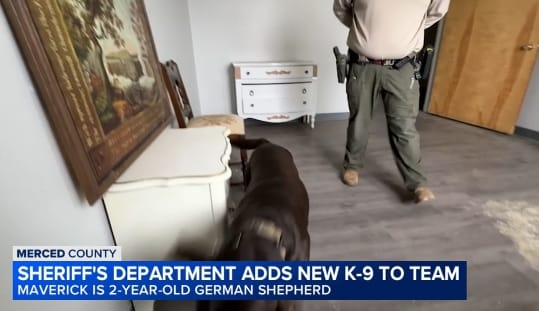
Maverick at work during training. Good boy!
Maverick joins Merced SO
ABC30. Merced County Sheriff’s Office welcomes new K9 to force.
Synopsis: Maverick, a 2-year-old German Shepherd, will join the other eight members of the Sheriff’s Office K-9 Corps. The dog came from The Netherlands and will be teamed with handler Tyler Norris. Maverick was brought to Merced by the Merced Sheriff’s K-9 Association.
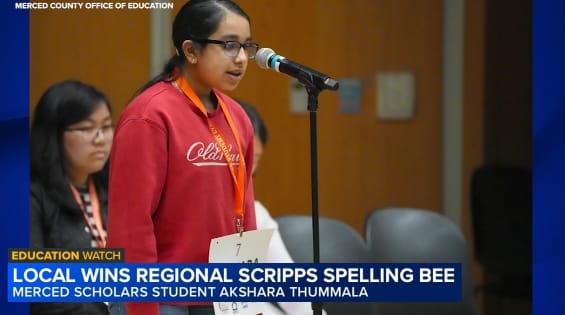
Akshara Thummala can spell just about anything.
Merced’s top speller advances
ABC30. Merced County student reaches Scripps National Spelling Bee.
Synopsis: Akshara Thummala, who attends Merced Scholars Charter School, took first place in the Scripps Regional Spelling Bee over the weekend, spelling “untenable” correctly. The victory qualified Akshara for the Scripps National Spelling Bee in Washington next month.
Host a player, get a pass
Modesto Bee. Want free tickets to a full season of Modesto Roadster games? Host a player.
Synopsis: Modesto’s new baseball team, which plays in the semi-pro Pioneer League, is looking for housing for some of its players. If you agree to let a Roadster sleep over, and feed them, you get season tickets. The season lasts from early May to late September. So far, 15 families have volunteered, including some who hosted Nuts players in the past. Nancy and Steve Day hosted Nuts for 17 years, with one becoming their son-in-law.