- Adam Gray Valley Solutions
- Posts
- Valley Solutions

Valley Solutions offers a daily look at the top headlines appearing on media websites affecting the San Joaquin Valley. It is compiled by Mike Dunbar, who worked in Stockton, Modesto, Merced and Los Banos media for 40 years and later served as Adam Gray’s press secretary when he was in the Assembly. Valley Solutions is brought to readers by Rep. Adam Gray.
Reach Mike Dunbar at [email protected].

This farm land would become houses as part of Riverbank.
River Walk a hot topic
Modesto Focus. Political Focus.
Synopsis: Garth Stapley devotes the top of his weekly politics column to River Walk, the giant development that would plant Riverbank several miles west of the current city on McHenry Avenue. Leading the charge against this is longtime farmland preservation advocate Denny Jackman, who is campaigning to pass Measure M to limit growth without voter permission. Many say the city is rushing to approve River Walk’s 2,400 homes before Measure M would outlaw it in November. … In other political news, data centers are becoming a hot topic in CA-13. The website Legal Planet points out that Kevin Lincoln’s website contains an enthusiastic embrace of data centers. “Kevin supports the President’s AI Action Plan,” reads the website for the man challenging Rep. Adam Gray. Garth says he would like to ask Lincoln about this support, but so far Lincoln has ignored Garth’s requests for an interview or to participate in a debate with Gray.
MAD Take: The current city of Riverbank has 7,600 housing units. Doing the math, 2,400 new homes is a 30% expansion of the current city. How does any city pay for such an expansion in a single gulp? It doesn’t. Taxpayers do. Meanwhile, those living in existing homes take a backseat to the needs of the new builds. That’s why it is important to ask residents if this is what they want. … As for Lincoln, he appears to be hiding from both Garth and Rep. Adam Gray. Odd. Lincoln has based his entire campaign on being a Marine, referencing their well-deserved reputation for bravery. But hiding from voters and opponents seems, well, cowardly. Maybe he’s worried someone will ask him where he lives (his campaign office isn’t even in the district). Or why he named his new company Goldberg Stern LLC when no one in his family is named Goldberg or Stern? Or why he mimics Trump in saying he wants to build lots and lots of data centers?
Is Measure M even legal?
Modesto Bee. Impartial analysis? Riverbank city attorney tells voters Measure M is unlawful.
Synopsis: City attorney Tom Hallinan wrote that Measure M – which would require a public vote for growth proposals in Riverbank – would break four state codes or laws, adding there are “serious questions” about its enforceability. Measure M would require the city to put the River Walk proposal to a vote instead of allowing it to pass on a city council vote. Denny Jackman, a former Modesto councilmember, says Hallinan is reading the law incorrectly. David Colnic, who chairs Stan State’s public administration department, said Hallinan’s approach “appeared to be overly cautious.” Posting on social media, one observer said there wouldn’t be a need for Measure M if the council would listen to voters.

Madera Speedway’s paved track.
Fast-track to controversy
Fox26. Madera Speedway owner says social media post sparked threats, backlash from ‘mob.’
Synopsis: Madera Speedway owner Kenny Shepherd said he was only joking about giving Republicans a discount on tickets and charging Democrats more to attend his Harvest Classic race. Some people didn’t see the humor. “There’s been threats, really nasty threats,” he said. “I had someone send a picture of my house.” Shepherd said GOP candidate for governor, Steve Hilton, has been invited to be his grand marshal. The controversy has been good for business, said Shepherd, and he might have a sell-out.

Can data centers be efficient?
Maven’s Notebook. The energy and water footprint of AI.
Synopsis: Edward Ring of the CA Policy Center writes about significant improvements in cooling data centers. He starts from the position that any impacts on local communities must be minimized, but then says today’s concerns are overstated. The Abundance Institute reported that water consumption by data centers is moving to “almost nothing.” Two years ago, the data centers used 2.5 liters per kilowatt hour. Now, with closed-loop cooling, they’re using only 0.12 L/kWh. Facilities built in New Mexico and Michigan for Oracle this year report no evaporation, blowdown or need for “continuous makeup-water” systems. There are also efficiency improvements in electrical use.
MAD Take: No doubt that data centers will become more efficient in power and water consumption; after all, power and water are expensive. But until there are guarantees that such technology will be adopted, every community must remain vigilant in considering such facilities. Developers will stick to old technology until it’s more profitable to use the new tech.
Wall Street Journal. The startup that built OpenAI’s biggest data center is now making tiny ones.
Synopsis: Texas-based Crusoe made its name building hyper-scale data centers. Now it is shifting gears, investing in smaller centers with prefab components that can be loaded onto flatbeds, trucked anywhere and assembled in a matter of days or weeks. “The idea is that this will be faster and cheaper than solely relying on large construction projects.” The company started building data centers to “mine” for cryptocurrency. Crusoe now “makes money at several layers: developing and leasing data centers, renting out GPUs inside them or running AI models for customers and charging for the computing output, known as tokens.”

Senate Ag Committee as it moved the Farm Bill forward.
Farm bill advances in Senate
Successful Farming. Farm groups react after Senate Committee advances 2026 Farm Bill.
Synopsis: Mitch McConnell’s first vote since his near-death experience allowed the Senate Ag Committee to move the 2026 Farm Bill out of committee for a vote by the full Senate. Among those praising the vote was the Ag Bioeconomy Coalition, which pushes for biofuel development, the American Farm Bureau Federation, and groups representing processors of soybeans, corn, ethanol, produce, sorghum and meat. Not every organization was happy. The National Family Farm Coalition said the bill is filled with “the same tired, out-of-touch policies that got us here.” The National Farmers Union said the bill “delivers some real improvements,” but “will not stop the crisis farmers are caught between rising input costs, concentrated corporate power and a farm safety net that no longer reflects the realities of farming.”
Farmdoc. Ag Committee advances Farm Bill 2.0 to uncertain future in full senate.
Synopsis: Ryan Hanrahan compiles a story looking at coverage from Agri-Pulse, Progressive Farmer, The Hill, AgWeb and others. He writes that the farm bill will need 60 votes to avoid a filibuster, and it won’t have time to get them before the recess. The most contentious part of the bill is the “Save Our Bacon” provision which nullifies laws in states like California, Massachusetts and Illinois that set rules for products sold within their boundaries. Major pork processors who raise pigs in tightly confined spaces have fought CA’s requirement for humane treatment of animals. Sen. Chuck Grassley said if that effort succeeds, he will offer an amendment to change CA’s similar rules on henhouses.

Stockton cracked down on smoke shops similar to this one is in Fresno.
Getting into the weeds
GV Wire. $7.4 million grant to help police, investigators bring down illegal weed in Fresno.
Synopsis: A $7.4 million state grant will help the Fresno police and city attorney’s office crack down on illegal cannabis sales. The money will be used to investigate illegal sales at unlicensed shops, clean up neighborhood blight and tactical support. Police chief Mindy Casto said it will “prioritize public safety, protect our licensed businesses and safeguard Fresno’s young people from the dangers associated with unregulated drug activity.”
Stocktonia. Up in smoke: 13 Stockton smoke shops closed in undercover police crackdown.
Synopsis: Stockton police shut down 13 smoke shops after conducting 162 inspections and issuing 50 citations in a massive undercover operation. The city council has declared the proliferation of smoke shops a public nuisance. The stores, spread throughout the city, were cited for selling flavored tobacco products to minors.
Patterson Irrigator. City, cannabis operator hash out a new tax deal.
Synopsis: Patterson’s original cannabis formula could be replaced by a 7% tax on all retail sales under a new agreement recommended Thursday by the Patterson Planning Commission. The Commission voted 4-0 to allow Catalyst to move to the former Patterson Frozen Foods facility on W. Las Palmas. Final approval must come from the city council. Under the original agreement, the shop had to make monthly payments of $25,000 or 5% of gross receipts. A commissioner questioned why the city should enter an agreement with an applicant who had failed to meet previous obligations.
Will budget cuts hurt kids?
Modesto Bee. Social workers warn Stanislaus Child Protective Services layoffs put children at risk.
Synopsis: Social workers went before Stanislaus Supervisors on Tuesday night to explain that cutting 67 staffers in the Community Services Agency will have a significant impact on children living in dangerous situations. Layoffs would hit 40 social workers, or a quarter of the entire staff. Thirty of the remaining social workers will be demoted to a lower classification with reduced pay.
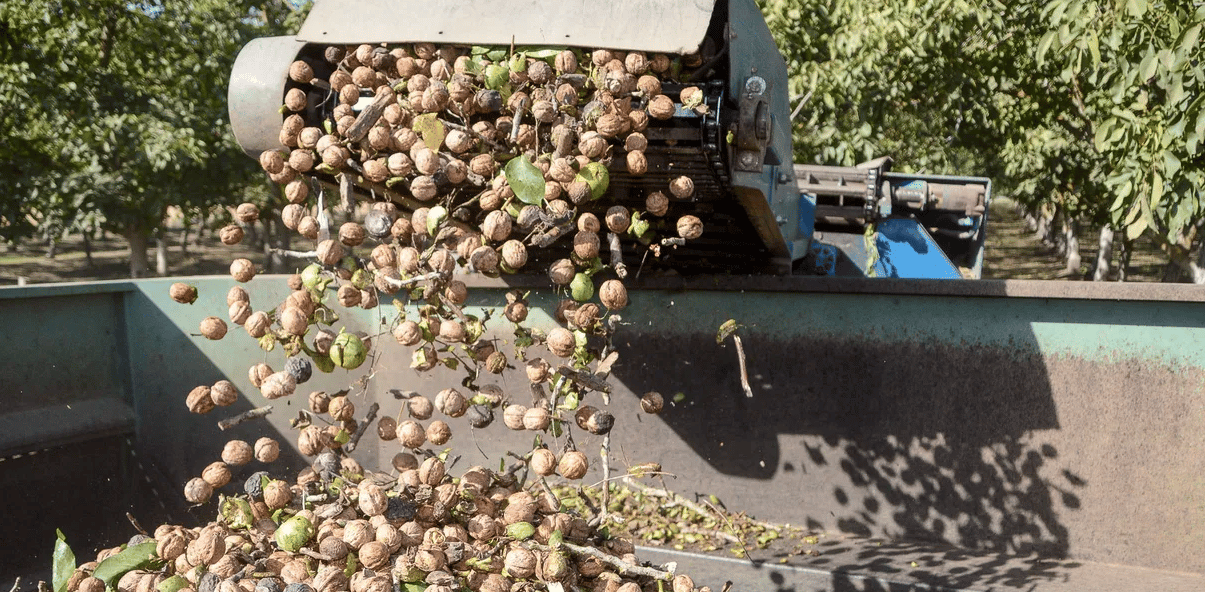
The value of walnuts made a huge leap in 2025, up 12.4%.
Ag value up 6.4% in San Joaquin
San Joaquin Ag Commissioner. Farming’s contribution to SJ County rises 6.4%.
Synopsis: Ag commissioner Kamaljit Bagri told the San Joaquin supervisors that the value of the county’s ag production rose 6.39% in 2025 to $3,356,227,000. The county’s top commodity was almonds, whose value rose 10.2% to $584 million followed by milk at $556 million, and walnuts, up 12.4% to $306 million. Eggs ($283M) and grapes ($272M) rounded out the top five. The value of grapes fell 14.8% from 2024. Bagri said the top five export commodities from San Joaquin are almonds, walnuts, rice, onions and cherries with Japan, India, South Korea, Taiwan and Turkey being the largest customers. She said her department monitors the county for 12 different pests, setting out 8,278 traps last year.
Party time for oil industry
Wall Street Journal. Barrels of sake and rooftop galas: Energy traders toast the war boom.
Synopsis: At least one group of people is happy the war in Iran is dragging on -- energy traders. They’re getting fabulously wealthy as the price of oil surged past $100 per barrel. They’re throwing lavish parties, pouring sake from barrels. Though the US produces more than enough oil to meet its needs, refiners have raised prices on gas and diesel to match worldwide demand. President Trump has criticized US oil companies but done nothing to curtail windfall profits. The story describes parties at private clubs with chefs carving 4-foot tuna into sashimi and “elegant women in bright-red pencil dresses handing out drinks.”
MAD Note: A story Wednesday noted oil companies have reaped a $36 billion windfall since the war began. That has come at an average cost of $2 a day for every American driver.

Tariffs last straw for McManis
Sacramento Bee. 3,500-acre CA winery for sale following hits from Canada’s ban on US alcohol.
Synopsis: Lost wine sales in Canada since the Trump trade war began broke the last straw for McManis Family Vineyards. The family-owned winery farms 11 parcels, including the one around its state-of-the-art winery on River Road east of Ripon, totaling more than 3,500 acres. Its winery produces 75,000 cases per year but can bottle up to 3 million. Sales to Canada once made up 40% of the family’s business but now is only 5% since tariffs were imposed. A Napa real estate broker said it’s “almost impossible” to sell a wine vineyard in the current economic climate.
Money, drugs, guns … and a gator
LA Times. Feds find small alligator, 42 kilos of fentanyl in downtown LA luxury apartment.
Synopsis: Federal agents raided a luxury apartment in LA, finding 42.6 kilos (92 pounds) of fentanyl, a kilo of heroin, high-powered weapons, a gold-plated Desert Eagle pistol … and a small alligator. Susan Gonzalez, 26, was released on bond, but Marvin Angelito, 27, was still in custody. A K-9 deputy was overcome by fentanyl and had to be given Narcan during the raid. US Fish & Wildlife was called to the apartment to rescue the alligator.
MAD Take: Sounds like a cross between Pablo Escobar and Tony Montana.