- Adam Gray Valley Solutions
- Posts
- Valley Solutions

Valley Solutions offers a daily look at the top headlines appearing on media websites affecting the San Joaquin Valley. It is compiled by Mike Dunbar, who worked in Stockton, Modesto, Merced and Los Banos media for 40 years. Valley Solutions is brought to readers by Adam Gray.
Reach Mike Dunbar at [email protected].

MID: The conflict of interest on board vote was ‘obvious.’
Byrd’s conflict of interest clear
Modesto Bee. Modesto water director had clear conflict of interest, ethics experts say.
Synopsis: Reporter Trevor Morgan talks to ethics experts about the Modesto Irrigation District vote on director Larry Byrd’s use of water to grow almonds outside the district. Instead of recusing himself, as another board member did, Byrd was part of the 2-2 vote that resulted in the investigation being killed. Stan State poli sci professor Gerard Wellman said the “easy, obvious” choice would have been for Byrd to recuse himself. Wellman’s not alone. Another professor said recusing on such a vote “goes without saying.” Sac State’s Christina Bellon, who specializes in questions of political ethics, said the vote was a “standard case of conflict of interest” and Byrd should have stepped aside. If he had, the vote would have been 2-1 to continue the investigation. With his vote, the investigation ended. MID’s legal counsel said the director has “the right to defend himself,” so it allowed the vote. The state’s Fair Political Practices Commission said it will not comment on the case. The story points out that “MID is the first line of defense of its resources. It’s unclear what agency or department can continue an investigation into Byrd’s alleged theft, misuse or misconduct if (MID) fails to police itself.”
MAD Note: The Tuolumne River does not belong to Modesto Irrigation District or its directors. It belongs to the people of California, who have allowed MID to manage the use of this since 1887. The state not only has an interest in the water, it has an obligation to see that the Tuolumne is used both beneficially and legally.
What’s ahead for ag in 2026?
Western Farm Press. What will be the news in the West in 2026?
Synopsis: Editor Todd Fitchette takes a languid look at various crops – cotton, citrus, beets – and factors that could affect them going forward, such as falling land prices and closing processing plants. He finishes up by repeating a question he asked last year: Will Ag Sec Brooke Rollins visit California? So far, she hasn’t – though she has criticized Gavin Newsom for his plan to help young people acquire farmland.
MAD Note: Like Rollins, Fitchette used the term “redistribute” in talking about Newsom’s plan to help Latino, native, veteran and poor residents acquire farmland. The program put $128 million into grants to help individuals buy land if they promise to keep farming it. With the average farmer pushing 60, don’t we need young people willing to do this work? And what’s the difference between providing grants to purchase land vs. providing property tax relief through the Williamson Act if keeping land in production is the goal? In Tulare County alone, the Williamson Act forgives $60 million a year in property taxes for farmers (based on land valuation of $6 billion). Is giving farmers a break on taxes at the expense of homeowners also “wealth redistribution,” or is there another name Todd prefers? We need the Williamson Act to make farming affordable; we also need programs to encourage young people to push the plow.

Will CA finally crack down on drunk drivers?
Laws to target drunk drivers
Cal Matters. Lawmaker targets repeat drunk drivers to fix problems exposed by CalMatters.
Synopsis: A bipartisan coalition of lawmakers has reacted to a stunning series of stories by reporters Lauren Hepler and Robert Lewis by introducing a package of bills to crack down on repeat drunk drivers. The stories pointed out that traffic fatalities have risen by 50% in CA even as they have fallen in other states. Some drunks get a dozen DUI arrests and still are allowed to drive. Assemblymember Nick Schultz offered a bill that would lower the number drunk-driving arrests required to be charged with a felony from four to three. Another bill will make it easier to put repeat DUI offenders in jail and require interlock ignition. Another would also suspend a drunk’s license for 10 years after the fifth DUI. Republican Tom Lackey of Palmdale is carrying three DUI reform bills and Sen. Bob Archuleta is vowing to act after his granddaughter was killed by a drunk driver. Prosecutors across the state are calling for even more strident reform.
MAD Take: Three DUIs before it’s a felony? Sounds like a half measure, and we’ve had enough of those.

Enrollment is up at all UCs, including UC Merced.
UC enrollment tops 300K
ABC10. UC enrollment tops 300,000 for first time as in-state student numbers reach record high.
Synopsis: Our 10 UC campuses have a total of 301,093 students, the first time the system has surpassed 300K in its history. That includes more than 200,000 students from California, marking a 5.9% increase since 2021. Graduate enrollment was up, but only by 0.3%; those seeking master’s degrees rose sharply to offset a drop in those seeking doctorates. Data also shows 68% of students have no debt.
Professor sanctioned over tweet
Sacramento Bee. UC Davis releases investigation after professor threatened Jewish journalists.
Synopsis: UC Davis assistant professor Jemma DeCristo was suspended without pay for the entire quarter after she used social media to threaten Jewish journalists and their families. She tweeted that reporters “have addresses and kids in schools. They should fear us more,” decorating the post with emojis of a knife and ax with red droplets. She was posting in response to Israel’s attacks on Gaza but said she considered it “overt satire.”
MAD Take: Doubt the journalists saw the satire.
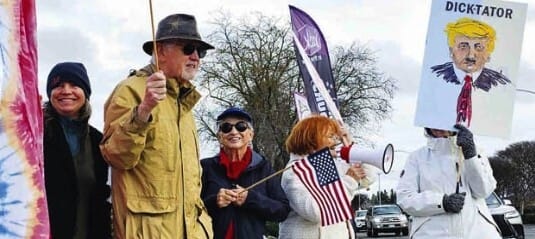
Merced protesters, a committed bunch.
Keeping Trump protests alive
Merced County Times. Local Trump protests continue amidst Venezuela news.
Synopsis: Like every Saturday, a small group of dedicated protesters came out to Olive and M to display their anger with Donald Trump. Last week they decried his incursion into Venezuela. The same group has been gathering on Fridays along M Street at Courthouse Park. Gloria Sandoval told the reporter that national change begins with local action.
Supervisor paid $30K for PR
Fresnoland. Former Fresno councilmember used $30K in taxpayer funds for Facebook ads in election.
Synopsis: In Part 2 of the “Under the Radar” series, Supervisor Luis Chavez comes under scrutiny for payments he made to a political consultant while he was a member of the Fresno City Council. In July 2024, four months before his election to the Fresno Board of Supervisors, Chavez authorized spending $30,000 with Alex Tavlian’s company for public relations services. Over the balance of the year, he spent $99,999 with Tavlian – peaking in October. That same month, Tavlian’s firm paid $7,626 to post false ads on Facebook accusing Chavez’s opponent, Sal Quintero, of supporting a MAGA plan to censor books. Apparently, social media expenditures are counted differently under city codes that limit city councilmember PR expenditures. Councilmember Miguel Arias says, “They’re skirting the policy.”
Fresno Bee. Fresno leaders held news event on ‘transparency;’ they wouldn’t take questions.
Synopsis: Reporter Thadeus Miller writes about Wednesday’s hastily called news conference in which two Fresno city council members discussed transparency “then walked out after five minutes without taking questions.” Councilmembers Brandon Vang and Nick Richardson said more transparency is needed, then left without providing any context. They appear to be responding to Fresnoland stories that detailed the use of no-bid, no-vote contracts by councilmembers to pay political consultant and Valley Sun publisher Alex Tavlian more than $100,000. Vang -- the target of a smear campaign run by Tavlian’s company -- said he will “be pursuing all avenues” to recover the money.
Spillway flows a good sign
Mercury News. Water pours down Oroville Dam spillway as reservoir rises following big storms.
Synopsis: The spillway at Oroville Dam opened this week, normally a sign the state’s water supplies are sufficient for the coming year. The tallest dam in the US, Lake Oroville rose 70 feet this week and currently holds 2.7 million acre feet. That’s 127% of normal for this time of year and around 77% of total capacity.
First case of new flu was in Merced
MSN. First US case of H5N9 bird flu strain found in CA.
Synopsis: A case of bird flu variant H5N9 – not the usual H5N1 – was found for the first time in the US in Merced County back in 2024. The CDC report said sick birds were found on a duck farm, but the exact location was not released. The investigation opened in November 2024. All 118,954 birds at the farm were killed and the area was quarantined.
MPD data shows 21,485 stops
Modesto Bee. Modesto police stops doubled in 2024; who was stopped and why?
Synopsis: The Modesto PD conducted 21,485 stops in 2024, more than double the number from 2023. State law requires agencies to track and report stops while collecting data on the ethnicity, age and gender of those stopped. Hispanic residents, who make up about 44% of Modesto’s population, were the targets of 43% of the stops. Black residents were stopped at double the rate of their population, or about 10% of the time. Black individuals also accounted for the highest percentage of stops resulting in no action – 24%. Most of the stops were for drivers (62%), with cyclists (4.3%) and pedestrians (34%) making up the rest. Men were twice as likely to be stopped.
Tracking flows and aquifers
Maven / DWR. Central Valley Flood-MAR dashboard integrates flood and groundwater management.
Synopsis: The Dept of Water Resources is showing off its new water-tracking tool, a computer dashboard that provides dynamic or real-time tracking of stored water. DWR has invited local water agencies to review the system and offer feedback. Maps show tracking stations on rivers and current flows.

Instructor Natalie Borba and four Atwater students in Pasadena.
Behind the scenes of Rose Parade
Merced County Times. AHS floral students take part in Tournament of Roses Parade.
Synopsis: Four Atwater High students were in Pasadena working as volunteers on the Kiwanis International floats. Student Alexa Barton called it an “exciting and unique experience.” Instructor Natalie Borba accompanied the students, saying the trip was paid for by student-led floral fundraisers and projects. The students put in 12-hour days affixing flower blossoms to floats. Laurel Peterson called it a “once-in-a-lifetime experience with my closest friends” that was “truly unforgettable.”
