- Adam Gray Valley Solutions
- Posts
- Valley Solutions

Valley Solutions offers a look at the top headlines appearing on media websites across the San Joaquin Valley and beyond. It is compiled by Mike Dunbar, a former editor at The Modesto Bee, documentary filmmaker and press secretary for Adam Gray when he was in the California Assembly.
Reach Mike Dunbar at [email protected].

Part of the complex to siphon more water south.
Two views on Delta Tunnel
Maven / DWR. DWR committed to building climate resilient Delta to benefit people, farms, fish.
Synopsis: The Department of Water Resources published an unsigned statement offering a justification for building the tunnel while releasing a new map showing “dozens of projects and programs aimed at building Delta Resilience.” It notes that runoff from 40% of the state’s landmass enters the Delta where it mixes with saltwater from San Francisco Bay. Every island in the Delta has flooded “at least once since farmers began reclamation in the late 1800s,” and a tunnel would make such floods more manageable. Climate projections suggest larger storms and more runoff earlier in the year, impacting the Delta and its ability to supply water to the state’s major population centers. The tunnel will be the easiest way to assure continued deliveries of Delta water to points south.
Manteca Bulletin. True cost of building Newsom’s tunnel can be found in what’s left of Owens Valley.
Synopsis: Columnist Dennis Wyatt likens the state’s tunnel to the LA Aqueduct, which siphoned off most of the water from Owens Valley and sent it to Los Angeles. “While the mechanics may differ, the two projects are mirror images of each other in that they divert significant water from nature’s course to make one region a winner and another a loser.” It’s not just Owens Valley that LA has ruined, there’s also Mono Lake. Bottom line: “Do not be fooled. The Delta tunnel is Owens Valley 2.0 but on steroids in terms of environmental and economic damage it will foist upon a region hundreds of miles away from the Sunset Trip.”

The view of the tunnel from the Delta.
Justice, yes; vilifying Sikhs, no
Fresno Bee. Valley Sikh truckers face backlash of Florida politicizing a tragedy.
Synopsis: Naindeep Singh writes that he, too, wants justice for the three people who died on a Florida turnpike when a CA trucker made a U-turn. But justice does not require Florida Republican to “politicize a tragedy, trading in fear and xenophobia while tarring an entire community of immigrants.” In our Valley, Punjabi Sikh immigrants frequently haul ag products as an entry into the workforce. They are essential workers in an essential industry. Now, online trolls try to “flatten” all of them into caricatures. When Florida’s lieutenant governor flew to Stockton to accompany law enforcement in the driver’s extradition, his purpose was to dehumanize the driver, “and a reminder of how quickly politics can strip away basic rights.” Bottom line: “Divisive and racist politics make us less safe.”
MAD Take: Not mentioned in the story, the driver lives in Stockton and works for a Ceres company.

Some of the flooding that happened in Texas.
Those floods could happen here
Fresno Bee. Lessons from Texas: CA cannot afford to delay flood protection.
Synopsis: Adam Borchard, executive director of the CA Central Valley Flood Control Assn, says our dilapidated levees and underfunded flood-protection system is “just one severe storm away from” a tragedy similar to the one that hit Texas this summer and killed 130 people. As most such stories do, he harkens back to the winter of 1861-62 when heavy rains and warm winter winds put virtually the entire Valley under 10 feet of water. USGS models show that a big enough storm could inundate 4,000 square miles of our state, causing $1 trillion in damages. To avoid this, we need about $30 billion in flood-protection improvements then hundreds of millions more for regular maintenance each year.

The new One Tree tents in Los Banos.
A better place for the homeless
Merced County Times. Los Banos pursuing camp-to-housing strategy.
Synopsis: The One Tree project in Los Banos has created a new approach to dealing with homelessness. It has 85 tents housing roughly 90 people on a lot near the police station. Residents are allowed to have pets and cook on grills and there are restrooms and a mobile shower facility on site. The area has video surveillance and patrols who provide security and outreach for those who want help. Before opening the camp, the city removed 80 tons of debris from a makeshift homeless encampment. The plan is working. Only three people have been asked to leave. One of the campers said she feels safer in Los Banos than in Merced, where people would steal her shoes as she slept. Christy McCammond and Jennifer Loa manage the program after having secured $11.8 million in state grants. Times editor Jonathan Whitaker says this is the first of three stories on the impressive Los Banos effort.
27 houses on 2 acres
Modesto Bee. Riverbank approves 27 small houses along Claus.
Synopsis: Developer Gary Lev said he hopes to keep prices for the 27 new homes under $400,000. The median new home price in Stanislaus is $495,000, so that’s much closer to affordable. He expects to start construction on the 2-acre site a block from Riverbank High this year. The houses are designed to push right up to the sidewalks with little room between the houses.

A pop-up street vendor in Merced.
Regulating pop-up kitchens
Merced Focus. Who gets to sell in Merced? City eyes new rules for street vendors.
Synopsis: The city says outdated regulations make enforcement of the city’s food-selling rules difficult. They want to tighten health standards, limit vendor locations and expand permitting authority to improve food-safety and reduce complaints. The city worries about sanitation and the temperature of stored food; it also wants to make certain vendors are properly insured. MPD Chief Steven Stanfield says his department hears frequent complaints about pop-up vendors taking over parking lots. There are also concerns about pop-up vendors unfairly competing with businesses who have paid permit fees and taxes. On the other side, pop-up defenders say new rules could criminalize “informal workers” who have few options for making money. Customers say “this is what we eat; this is what we like.” The vendors worry that the city will confiscate their equipment and levy hefty fines. City manager Scott McBride says lots of cities are facing similar issues since the state passed laws limiting rules cities can impose on street vendors.

The new tasting room at Ziveli Winery near Kerman.
Working off the farm
Ag Net West. Small wineries under pressure: Ziveli Winery.
Synopsis: Interviewer Nick Papagani spoke with John and Caleb Ziveli, whose family winery is between Kerman and Fresno. They’re facing declining sales, higher labor costs and higher prices on equipment along with more state regulations. This is the fourth generation trying to operate the winery, and several members of the family have taken off-the-farm jobs to help make ends meet.

Fire left this taqueria shuttered.
Details on arson charges
Fresno Bee. Was Fresno restaurateur a serial arsonist? Complaint details ‘modus operandi.’
Synopsis: Bobby Salazar became Fresno’s “king of Mexican food party platters.” Now he’s charged with hiring a motorcycle gang member to burn down one of his struggling eateries. If found guilty, he will spend at least 10 years in prison. The 18-page complaint shows a history of “using fire to solve business problems.” Authorities say he burned restaurants rather than settle disputes with former employees and even an ex-brother-in-law. Agent Kristin Loeffler detailed at least three fire-bombings in his businesses. Salazar has pleaded not guilty to all charges.
Ceres hit with insurance fees
Ceres Courier. Budget takes new hit from failing insurance group.
Synopsis: A self-insurance consortium that provides employee coverage benefits for 35 cities, including Ceres, is in financial distress after a “dramatic increase in claims” the past two years. A shortfall could cost the city $750,108 in unanticipated expenses. The city says employee benefits are not in jeopardy.

Employees at Modesto city hall can’t talk to reporters.
Bee: Dump city’s media policy
Modesto Bee. Editorial: Modesto needs to dump media policy that violates First Amendment.
Synopsis: The policy that bars city employees from talking to reporters without having high-level managers present shows a lack of transparency by the city. Such a policy leads to a chilling effect across government and serves the people of Modesto poorly. The editorial says city manager Joe Lopez’s insistence that this policy is just so he won’t be “surprised” by stories is “hogwash.” The Bee’s bottom line: “We suggest the city of Modesto drop its policy and embrace transparency.”
Stanislaus prosecutor honored
Modesto Bee. Stanislaus prosecutor honored statewide for work on triple-murder case.
Synopsis: Thane Nored has been named the CA District Attorneys Assn Outstanding Prosecutor of the Year for a Rural County. He led the 8-month trial that found Richard Tyrone Garcia guilty of a triple homicide in 2012. Nored worked the case with Stanislaus Deputy DA Marlisa Ferreira, who retired this year.
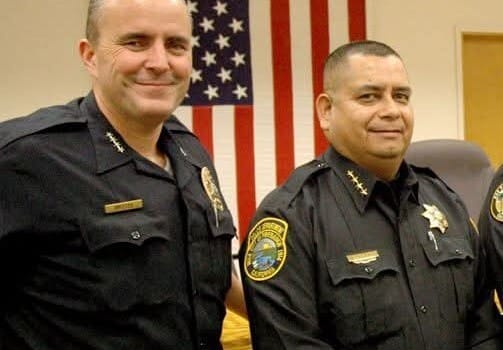
Sal Raygoza, right, will join Gary Brizzee in retirement soon.
So long, chief
Westside Express. Police chief Sal Raygoza to retire after decades of service in Firebaugh.
Synopsis: Firebaugh police chief Sal Raygoza, 54, is retiring. He started his career in 1994 as a dispatcher and rose to chief, a job he has held since 2015. Raygoza called serving the city the “greatest honor of my life.” A grandfather, he’s been especially active in Firebaugh’s youth programs.
